What the picture shows
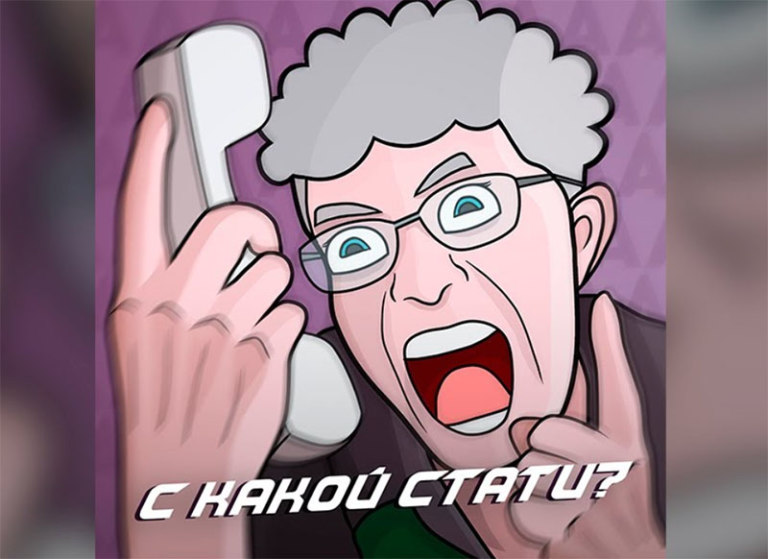
A cartoon illustration on a purple patterned background. At the center is an older woman with gray curly hair and glasses: her mouth is wide open, her eyes bulge, and her brows are raised. One hand holds a white telephone handset to her ear, and the other is raised with an outstretched finger, as if she is proving something. Across the bottom in large letters is the caption “S kakoy stati?”.
This is not a photo or a video still but a stylized drawing. The artist is unknown; the drawing refers to the sound and to the figure of an angry caller.
The story of the call
The source audio is a recording of a conversation posted on YouTube on October 17, 2012. According to retellings, the woman calls the support line of an electronics store and indignantly says that installing a washing machine should cost 3,600 rubles, while she is being asked for 5,600. The key line is built on these two numbers and ends with the question “S kakoy stati?”.
The only confirmed detail is the date the clip was uploaded; the rest is known from retellings. The caller's name is not public: she is a private person, and the meme rests on voice and intonation rather than on identity.
Back in 2020
The clip got new life in October 2020, when recommendation algorithms began showing it to new audiences. According to descriptions, the musicians Ksenon and Xbro made a remix of the voice with a beat, and videos were shot to that sound. The line about three thousand six hundred and five thousand six hundred became a recognizable quote.
Details about who else took part in popularizing the sound are not reliably confirmed.
Why it's funny
The intonation is what makes it funny: the heroine's indignation is sincere and escalating, while the reason seems trivial, and the numbers are delivered with absurd precision. The gap between the volume of emotion and the size of the problem produces the comic effect without demeaning the person: anyone who has ever argued over the amount on a bill can relate.
In addition, the phrase fits the rhythm of the music neatly, so it is easy to repeat and to plug in your own numbers.
Examples for your own caption
“They told me delivery was free, and now they're asking for 300. Why on earth?” This reproduces the structure of the original: an expectation, an unexpected sum and an indignant question.
“Promised a day off, but it turned out to be a mandatory volunteer workday.” The caption carries the same pattern from money into everyday life: what was expected and what happened have come apart.
“Coffee for 450, but the ad said 250.” Numbers play the main role again: the more precise the difference, the closer to the original.
“Yesterday the cat asked for food; today it sent the bowl back.” A variant without numbers, where the outrage is attributed to a pet.
Where else the formula shows up
The pattern “they told me one thing, it turned out to be another, why on earth” does not belong to a single recording. It is recognized as a classic customer complaint, so the sound easily fits any situation involving extra charges: a bank commission, a baggage surcharge, a delivery fee nobody warned about.
Because of this, the meme is not tied to a particular year and doesn't require knowing the original: the rhythm and intonation are enough.
How to use the picture
It suits reactions to any mismatch between what was expected and what happened, especially involving sums and deadlines. The simplest form is the picture with a caption naming two numbers: what was promised and what you got.
Keep in mind that the drawing shows a generic figure rather than a specific person: it is better not to attribute real biographical details to her in captions.