Where the word came from
The English word "selfish" means "egotistical," "thinking only of oneself." A Russian equivalent isn't hard to find, but at some point someone broke the English word down literally: "self" as "sam" (self/same), "fish" as "ryba" (fish). The result was a catchy word that looks like a translation, though in the ordinary sense there's no translation here at all.
The key point is that the word arose online as a memetic error, not as a dictionary entry. It grew out of a joking breakdown that shows how the English root splits into "self" and "fish." This device has long been familiar to Russian-speaking users, who love wordplay and clumsy translations.
How the word went online
According to available information, the spread began with a tweet from a student in Tver. The post quickly racked up reposts and went viral: the phrasing turned out to be short, funny, and well suited to comments. The exact circumstances of the first publication and its date could not be established from open sources, so what follows here relies on the general account rather than confirmed details.
From there the word was picked up on social networks and in communities. It was handy as a short label: instead of describing someone as "he only thinks about himself," one word would do. This gave rise to its own aesthetic — ironic, with a light touch of mock scholarliness.
Meaning and usage
In meaning, the meme denotes an egotist, someone who puts their own interests above everything else. It's often used for someone who doesn't want to share food, money, or time and who finds excuses for it.
An important feature is that the word often sounds like an excuse one makes for oneself: "I'm such a samoryba," that is, an admission of selfishness delivered as a joke. This softens the criticism and turns an awkward character trait into a joke, which is why the phrase readily shows up in chats and comments.
Interestingly, the mistake itself sounds convincing precisely because the word resembles an ordinary Russian noun. The reader doesn't immediately notice the substitution and only afterward realizes they're looking at wordplay. This effect is what gives the meme its staying power: it's enjoyable to decode, and anyone seeing the word for the first time goes through the same path from confusion to a smile.
Connection to the "deranged English lessons" genre
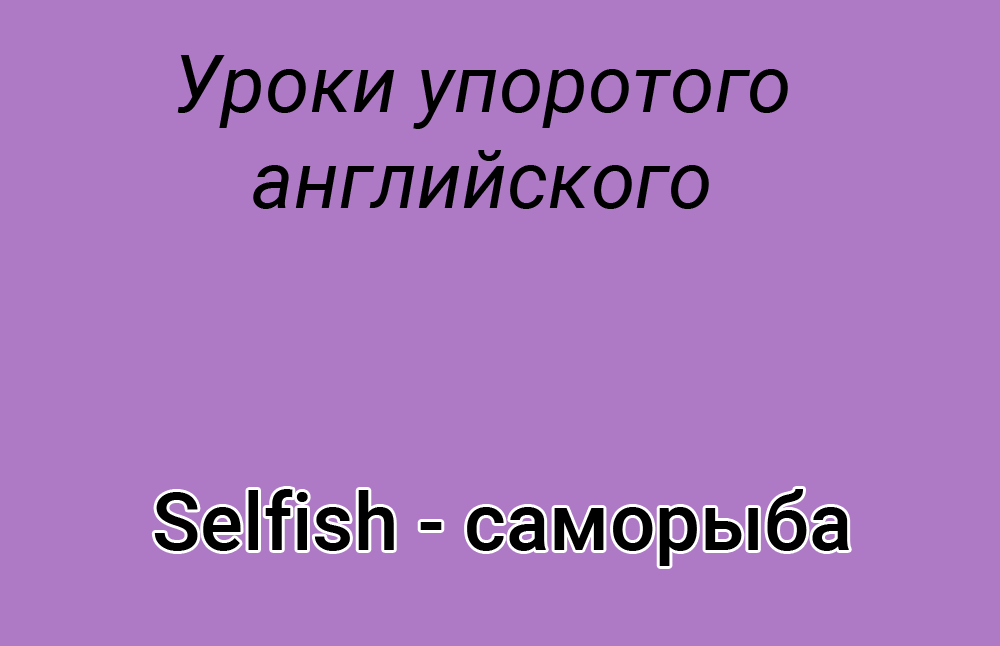
The picture captioned "Deranged English lessons" belongs to a genre in which translations, whether deliberately or by mistake, sound absurd. At the top is the series title, and at the bottom, in large type, "Selfish — samoryba." The contrast between the serious English word and the absurd Russian equivalent is exactly what makes the joke work.
The purple background and plain font underscore the homemade style of a meme meant for quick reading. Pictures like this are often made from a template, so they're easy to repeat and rework with new words.
Why the meme caught on
"Samoryba" is interesting because it combines wordplay with moral judgment. The word can't quite be called an insult, but it pins down the behavior precisely, and thanks to the humor, that criticism lands more gently.
The meme also shows how unofficial translations live on in language: one successful combination can take hold in speech for a long time and outlast the original joke.