What's in the shot
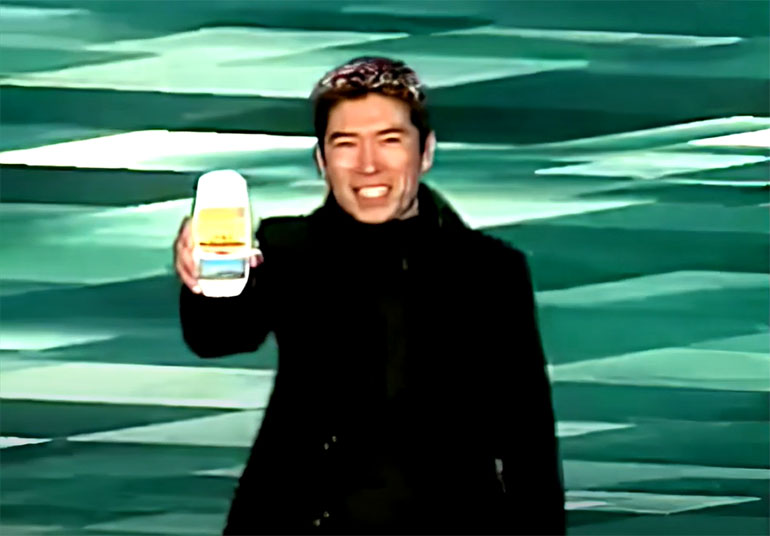
The shot is taken from a low-quality video. Against a green-turquoise background styled to look like waves or ice floes stands a man in a black coat or long jacket. His hair is styled, with a bright pattern on his head that looks like a hat or dyed streaks. He's smiling broadly and holding out a light-colored bottle with a yellow label in an outstretched hand.
The pose and the smile precisely mimic a TV commercial: the character presents the product to the viewer and holds it up facing the camera. It's exactly this earnest delivery, with no hint of a joke in sight, that makes the shot so funny.
Where the clip is from
According to available information, the clip is a parody ad for a fictional shampoo, made by Kazakhstani comedians around 2010 as part of a comedy program. It was uploaded to YouTube in March 2013. The sketch is credited to Marat Alibayev, who, reportedly, later filmed a sequel at viewers' request.
The plot is simple: the character is embarrassed to greet people he knows because of his dandruff, but after using the shampoo he becomes confident again. For Russian audiences, the real surprise came years later, when the video suddenly started showing up in recommendations: this was noticed around 2019–2020, though different sources give slightly different dates.
Why the name became a joke
Russian-speaking viewers took the word "Zhumaisynba" as an unusual brand name. It sounds complicated: a run of hissing and rolling sounds that's hard to pronounce on the first try. According to a common explanation, it's not actually a name but a whole phrase in Kazakh that jokingly hints at what the person is doing with the shampoo. The exact translation varies from one retelling to another, so what matters here is simply that the name isn't a random string of letters.
That's enough to fuel the meme. It arises at the intersection of two things: the earnest tone of the ad and a word that can't be understood without translation. The viewer isn't laughing at the language itself, but at how smoothly and confidently the character delivers something that sounds strange to him.
Example captions
Invented examples.
"The new coffee brand I couldn't manage to order out loud" — a joke about a name that's hard to pronounce.
"When they ask you about a technology at a job interview and you only know its name from having seen it written down."
"I introduce my parents to my new partner with the same confidence I'd use to advertise an anti-dandruff shampoo" — the same presentational swagger, but for a far more awkward occasion.
"When the salesperson is sure you'll remember the name right away" — the shot captures confidence that doesn't account for how hard the word actually is.
How to use the template
It works best in presentation-type situations: any product, idea, or name that the author is pitching with great enthusiasm. The more absurd the subject, the stronger the contrast with the earnest smile.
It's best to write the caption so that the original word is recognizable, or so that the name's difficulty is mentioned. If you just want to show off "the star of the commercial," a general caption like "Presenting the best product in the world" is enough.
Jokes shouldn't be built around nationality or language: what's funny is the confident tone and the odd-sounding name, not where the people involved are from.