Advertising image and a late caption
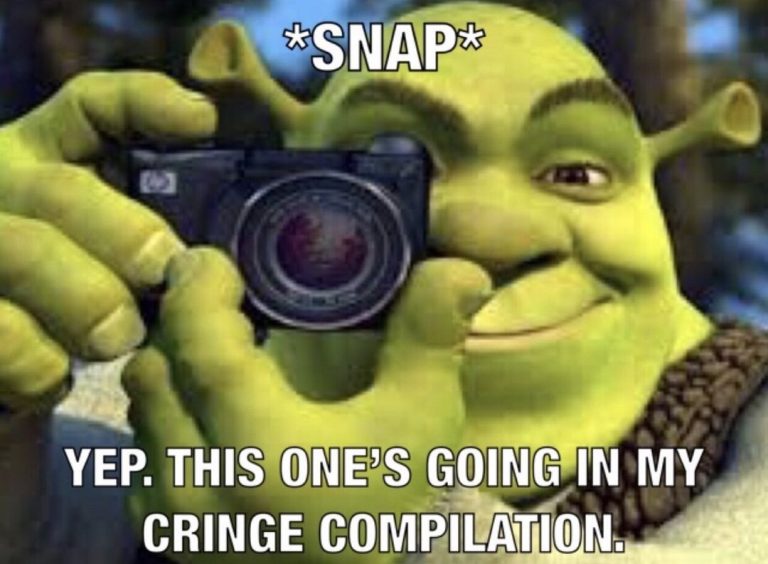
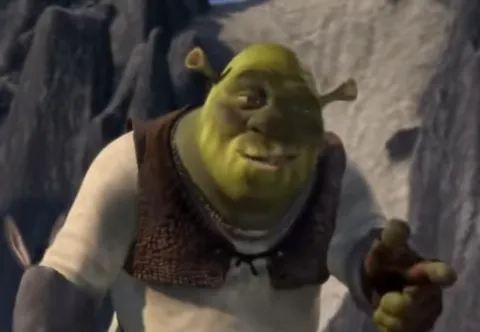
The image of Shrek with a camera has an advertising history separate from the meme. Artist Steve McGrath as early as 2015 posted in his portfolio a digital model of an HP camera that he made for an advertisement featuring Shrek. This confirms work on the advertising prop, but it does not allow pinning down the date of the whole scene or declaring it a frame from a found video. The assumption about a lost ad long accompanied the search for the original image.
The meme caption can be traced back to January 2018. Among the early recorded posts are a Gxbe post on iFunny from January 6 and the picture's spread on Twitter the following day. By mid-year the reaction had become noticeably more popular and received remakes with other characters. These traces establish early use, not a single proven author of the phrase. The joke itself arose from the added promise to preserve the awkwardness, which the advertising camera never implied.
The lens looks straight at us
Shrek occupies almost the whole frame and holds the camera in front of him. The large lens is aimed at the viewer; one of the hero's eyes is closed, the other looks forward, and a smile is visible on his face. Behind him is a blurred green setting. At the top is written SNAP, denoting a click, and at the bottom is the promise to send the shot to the cringe compilation.
The camera's position makes the recipient of the reaction the presumed object of filming. This is neither a selfie nor a photo of an already finished archive: the hero seems to have just seen something worthy of adding to a collection. The smile adds the observer's pleasure, so the caption sounds mocking rather than bewildered. The click at the beginning creates a small action between someone else's post and the decision to save it.
Awkwardness gets a place in the collection
“Cringe” is the name for the feeling of shame and discomfort when watching other people's actions. In this meme the viewer is portrayed not merely as someone who felt such a thing, but as a person who keeps a separate collection of such episodes. The word “compilation” gives the reaction the look of systematic work: what was seen seems to have passed a selection and earned a place beside other failures.
Such a gesture is stronger than an ordinary “I didn't like it.” It promises to prolong the life of an awkward moment and shows that the observer has already distanced himself from the author. At the same time, a real archive may not exist: the camera and the caption enact the very act of saving. The recognizable fairy-tale hero makes this role absurdly solemn. In remakes Shrek is replaced by another photographing character or the type of collection is changed, but the sequence “saw it, clicked, assigned a category” remains.
Three invented snapshots for the archive
The first new example is a school chat where a person boasts that he deliberately garbled the name of his own school for mystery. The Shrek picture answers that demonstrative attempt to look enigmatic. Another storyline: a salesperson records an inspiring video about discipline, while in the background hangs his own notice that the shop will open an hour later again. The camera emphasizes the observable contradiction between the pose and the surroundings.
In the third invented situation, a board game player delivers a long victory speech without noticing that the game is not yet over. The reaction preserves exactly that premature confidence. In all three cases the viewer must see a concrete awkward episode; Shrek alone, without a cause, would not explain what went into the archive. And the directed lens makes the response short and complete: the moment has already been noticed, and its imagined saving has become part of a new joke.