Formation in hoods
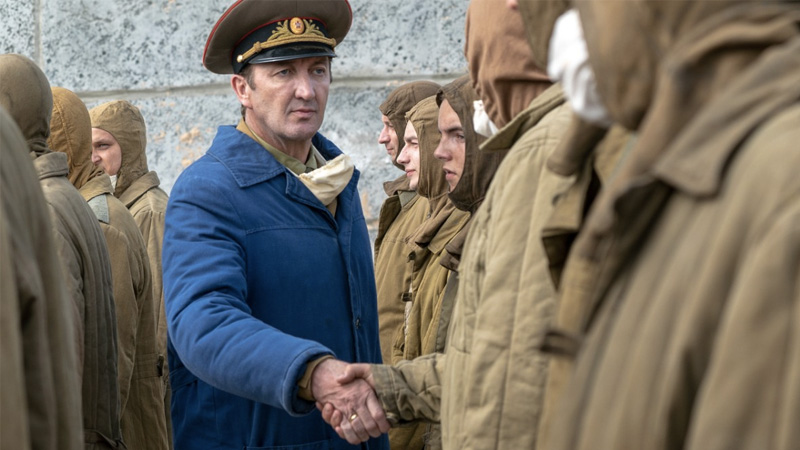
The frame shows an older man in a cap with red piping and a gold emblem on the peak. Over his uniform he wears a blue work jacket, and a light scarf is around his neck. He walks along the line and extends his hand to a soldier, who answers with a handshake.
The other soldiers stand shoulder to shoulder in sand-colored quilted jackets with hoods; one has a white mask visible on his face. The background is a pale stone wall. The tone is restrained and almost solemn, and this very seriousness makes it convenient for jokes: it is too big an event for a small occasion.
Scene from the fourth episode
“Chernobyl” is a five-part miniseries from HBO about the accident at the Chernobyl nuclear power plant in April 1986. The fourth episode aired on May 27, 2019. In it, actor Ralph Ineson plays General Nikolai Tarakanov, who thanks the people involved in the cleanup, and they reply with the customary formula.
The episode contains no comic moment: the scene is written as serious. The irony emerged later, when viewers cut out the frame and placed it in a different context. The first memes with it reportedly appeared on May 29, 2019, just two days after the episode aired, in a Reddit fan community for the series.
What the phrase means
“I serve the Soviet Union!” is a serviceman's reply to an announced gratitude or commendation. In army usage it is a strictly formal line, spoken loudly and without thought, because the form of the answer is set by regulations. That is why it sounds like an official pledge of loyalty without reservations.
What matters for the meme is precisely this: the phrase is too solemn to accompany trifles. When it is applied to tea, a subscription, or a pet at home, the solemnity turns into comic exaggeration.
How the phrase was taken out of context
The early variants were built on the theme of a shared cause and sacrifice: the first jokes were about sharing gum in class or deducting tax. By July 2019, such captions were already everywhere. The meme quickly stopped being tied to the series: a frame with a handshake and the word “serve” was enough.
The scheme is simple: on top, an ordinary situation in which someone gave something or did something; below, the frame with the handshake. The smaller the act itself, the stronger the effect. Gratitude for a heroic deed and gratitude for a forwarded link sound identical, and the joke is built on that gap.
Caption examples
“Me when a colleague writes ‘thanks for the spreadsheet,’ even though I sent it four times.” A minor task gets solemn gratitude, and the joke sounds like a small compensation.
“My cat when I open a can of food.” Here the oath of loyalty is addressed to food, not to the state.
“Me to my alarm clock when it finally wakes me up on Friday.” A tired person salutes an object that suffered too.
“Subscribers when a blogger says ‘thanks for being with me.’” Ironic mutual loyalty with no tension at all.
Tips
The caption should be short and name the context of the act. The more mundane the occasion, the better the contrast with the serious frame works.
Do not use this template for jokes about real victims of the accident or about people who actually worked on the cleanup. The frame comes from a dramatization, and the humor here rests on the solemnity of the formula, not on the catastrophe itself.