Origin of the format
The exact author of the first starter pack has not been established: open sources offer no reliable indication of a specific creator, and the collages themselves were typically published without attribution. The format is most often linked to English-language platforms of the early 2010s, where users assembled images "for beginners": a starter pack for a hipster, a gamer, a first-year student, or a programmer. The name was borrowed from the gaming industry, where it refers to the initial set of items a player receives at the start of a playthrough.
In the Russian-speaking segment of the internet, the format caught on under the name "starter pack" around 2014, when collages like these began appearing en masse in social media feeds and on themed sites. The dating here is approximate: it's based on when the first popular Russian versions appeared and on the date given in the entry, and the exact date of the first publication is unconfirmed.
How the meme works
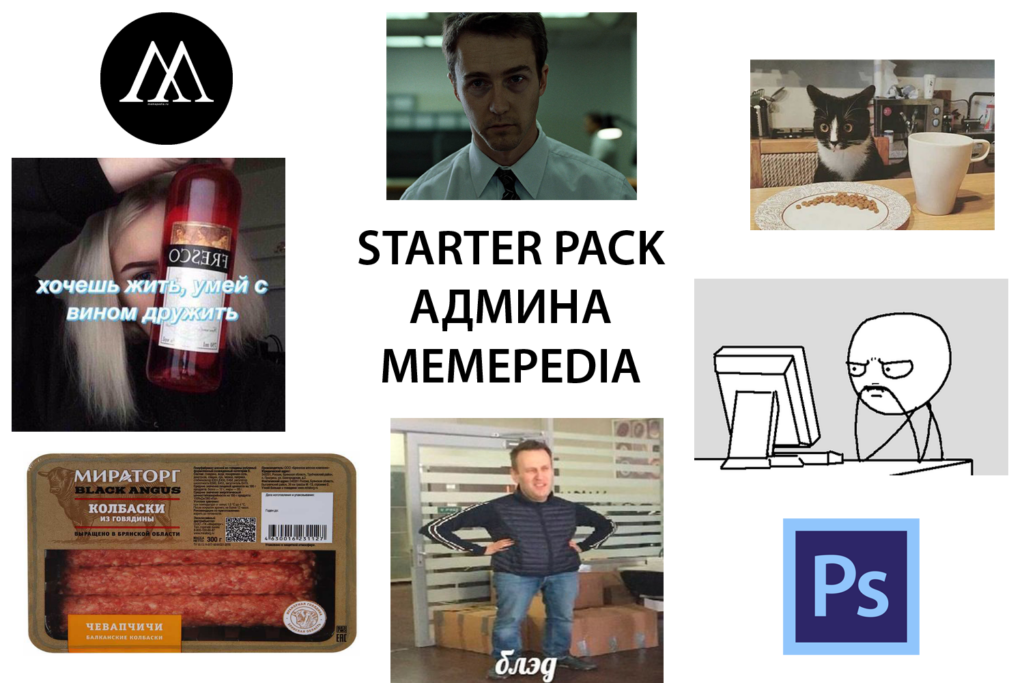
The classic form of a starter pack is a grid of six to twelve images depicting items typical of the chosen group. The elements can be photographs, movie and TV stills, meme images, brand logos, and everyday objects. A caption or title is often placed in the center of the collage, setting the theme and serving as the key to reading it.
The format's main feature is its reliance on references. The viewer has to recognize each item, and it's precisely that recognition that triggers the laugh. The starter pack therefore works as a test of belonging: someone who gets all the references feels, in effect, handed a membership card to the community, while someone who doesn't is simply looking at an in-joke from someone else's circle.
Spread in the Russian-language internet
In Russian-speaking communities, starter packs quickly moved from general topics to local ones: packs appeared for students, programmers, gamers, minibus drivers, people with dachas, and fans of particular shows. The collages were posted on VKontakte, on Pikabu, and in Telegram channels, where they racked up plenty of reactions thanks to how quickly they were recognized.
The format also became a handy tool for communities and editorial teams. Admins of themed groups and bloggers made starter packs about themselves or their audience, and the move worked both as a sign of belonging to the topic and as a way to show self-irony. Over time, this device became one of the standard forms of humor in themed chats.
Variants and typical moves
The most common device is choosing items that contradict a group's official image. For example, an "adult person" starter pack might include a childish item front and center and something thoroughly mundane in the corner. This contrast creates a comic effect and reads well to anyone who recognizes the situation being described.
There are also subtler variants: an IT-worker's pack built from a laptop, an energy drink, and a tech-support chat window, or a teacher's pack assembled from a stack of ungraded papers and a mug of cold tea. Collages like these lean on a profession's internal codes, so their humor lands most clearly with people who are actually part of that world.
What lies behind the joke
A starter pack can be viewed as a form of ironic stereotype description. The collage compresses a long description of a subculture or social group into a handful of images, which is why the joke registers instantly. The format has a flip side too: stereotypes can easily be mistaken for a literal description, which is why authors often stress that their set is just a game.
Today the starter pack remains one of the most enduring templates of internet humor. Its staying power rests on a simple principle: almost any group of people has a recognizable set of things that can be joked about good-naturedly, and every new collage adds its own details to that set.