The March tournament for favorite animated films
In March 2018, Twitter user @yeeitsanthonyy published a Disney Pixar Movie Madness bracket. The well-known original post is dated March 22. The format echoed the March habit of filling in tournament brackets: sports teams were replaced with the titles of animated films. Instead of match results, a person chose which story they preferred over the other.
The filled-in versions spread along with discussions of the most unexpected choices. One viewer championed a nostalgic film, another picked a newer one; a third was annoyed by the very pairing in which two of his favorite works met too early. The meme turned out to be a convenient way to show taste through a sequence of comparisons. This is an amateur game played by viewers: the studio logos give the chart recognizability, but do not turn it into an official competition or a final quality ranking of animated films.
Two branches on a blue field
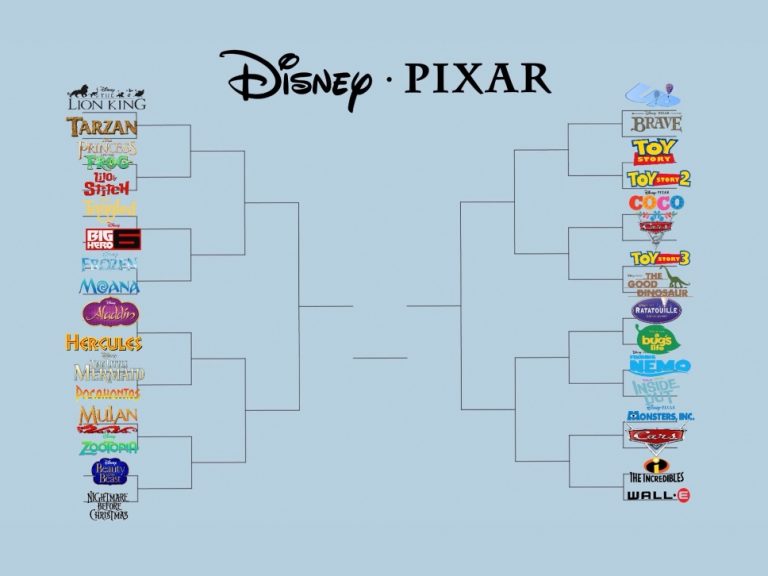
In the image, above the empty bracket, stand the Disney and Pixar logos. On the left are the titles of Disney films, among them “The Lion King,” “Tarzan,” and “Mulan”; on the right are, for example, Toy Story, Coco, “The Incredibles,” and WALL-E. The colored titles are gradually joined by thin lines leading to a central area. The overall background is light blue, and the central positions are still empty.
No winner is written in here. So the image shows the structure of the game before the choice begins. The first round forms specific pairs; in the next round, the already chosen favorites meet. Two films, one from each side, should remain in the center. This order forces several decisions in a row and makes the whole path of a beloved work visible, not just the title that a person is ready to declare the best right away.
Why a bracket provokes more arguments than a list
A regular list lets you place two favorite films side by side. A tournament requires giving up one of them if they meet in a pair. A person may consider both pictures beautiful, but the line still goes on with just one. That is why what hurts is not only the final decision, but also the early elimination of a film that could have gone much further with a different arrangement.
Another feature is the change of criteria. In one pair humor wins, in another music matters more, and closer to the final a childhood memory suddenly decides. The bracket makes such shifts visible: the viewer has to explain why a favorite side of a work turned out more important than this particular rival. The dispute concerns not a measurable result but different ways of valuing stories. The more familiar the titles, the easier it is for another person to mentally fill in the same lines and spot the divergence.
How different champions emerge
In an invented filled-in version, a person advances “The Lion King” to the final with the note “won because we rewatched it with the family,” while on the Pixar side they carry WALL-E to the final with the note “won because the main character is silent, and yet everything is clear.” The final sets two different grounds for attachment against each other: a personal memory and the impression of an artistic technique. A simple name of the winner would hide this conflict, but the bracket brings it to the last pair. Another invented participant decides the whole tournament only by the funny supporting characters and labels every box with a single word, “funnier”; his unexpected winners become understandable when he announces this common criterion, and the joke arises from strictly following a fairly narrow rule.
In a third sketch, friends fill in the bracket before a shared evening screening and, in the final box, write not a title but a conclusion: “once again we didn’t pick anything new,” since every winner has already been rewatched recently. The tournament successfully determined their tastes but did not help choose a new film for the evening. The familiar sports format promised a clear decision, but what it produced was a detailed map of why the group keeps discussing the same beloved stories.