Frame structure
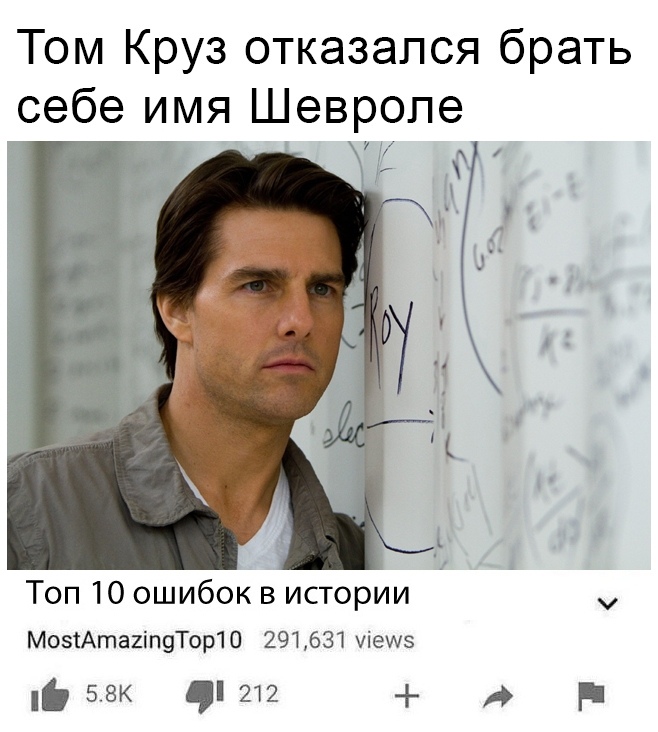
The image has three parts: at the top a large caption, “Tom Cruise refused to take the name Chevrolet”; in the center a photo; and at the bottom a strip that repeats the video hosting interface. It reads “Top 10 Mistakes in History,” the channel MostAmazingTop10, the view count (291,631), likes (5.8K), and dislikes (212).
The photo shows a man in a gray jacket and a light T-shirt standing and leaning against a white board covered in formulas and scraps of writing. He looks off to the side with a serious, puzzled expression. Which film or shoot the photo comes from cannot be determined from the picture, so the origin of the shot is not named.
The wordplay
The Chevrolet Cruze model sounds in Russian like “Shevrole Kruz,” and the actor's surname, Cruise, sounds almost the same. So “refused to take the name Chevrolet” reads as an absurd story that he could have become “Chevrolet Cruise.” This is an invented joke, not an event from a biography.
The irony is heightened by the fact that the caption sits in the frame of a video with a headline about “mistakes in history”: an invented fact is delivered with a serious face.
Where the format comes from
The “Top 10 Mistakes in History” format imitates compilation videos that collect views with loud headlines. The meme takes such a headline and substitutes an invented entry, often with a pun or a hint at a celebrity's name. When and by whom this template was first made is not established, so the date and author should not be given.
View and like counters at the bottom act as a “stamp of credibility”: people are used to thinking that view and like counts reflect popularity, and therefore truthfulness. The meme plays on this habit.
Why the joke is funny
The comedy works on two layers: the look of a credible video and absurd text. The viewer first sees familiar signs, such as the counters, likes, and a serious photo, and takes the caption almost as fact. Then comes the pause: it becomes clear that the “mistake” has nothing to do with history and rests on a single sound-alike.
The joke says nothing about the actor's real behavior. The meme uses a celebrity's surname as a marker of wordplay, not as information about his biography, and it is important to keep these apart.
Caption examples
Below are variants made up for illustration. All of them keep the structure of the headline; only the list item changes.
“Top 10 Mistakes in History: seventh, the person who believed the headline.” The caption turns the fake into self-irony for the viewer: the reader becomes the one who fell for it.
“Top 10 Mistakes in History: ordered a pizza with pineapple and called it a scientific discovery.” The invented item is funny because of the disproportion between the headline's serious tone and an everyday situation.
“Top 10 Mistakes in History: liking a video before watching it to the end.” A simple everyday mistake with a concrete verb, which sounds like a real list item.
How to use this template
The format works when the text is short and plausibly sounds like a headline. If the caption is too long or absurd without a hint of wordplay, the joke is lost.
Do not pass such a frame off as real news: the caption is invented, and the celebrity's name serves only as a pretext for the joke. If you make your own version, change the text of the item rather than adding invented events about real people.