Who is Ilya Varlamov
Ilya Varlamov is a Russian blogger, photographer, and urbanist, known since the mid-2000s, first as the author of a popular LiveJournal blog and later as a columnist who regularly criticizes the quality of the urban environment in Russian cities. One of the key themes of his publications is so-called “anthills” (chelovejniki, slang for dense high-rise housing blocks): residential towers in sleeping districts, which he systematically criticizes for lacking infrastructure, visual monotony, and uncomfortable density. This theme runs through many of his videos and posts, which made Varlamov's reaction to high-rises a recognizable part of his public image.
How the meme took shape
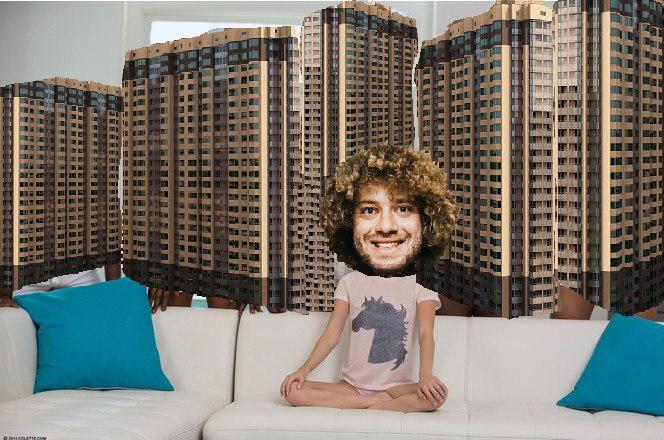
In the second half of the 2010s, photo edits began to circulate online in which Varlamov's head, usually taken from one of his characteristic photos with curly hair and expressive facial features, is pasted onto a small child's body sitting on a sofa against a wall of dense high-rise buildings. The contrast between the large, recognizable head of an adult and the small body of a child amplifies the comic effect, while the high-rises in the background act as a visual trigger, as if the sight of such development provokes an almost childlike reaction of irritation or panic in the meme's character.
The image in question is a typical example of this montage: Varlamov's head is placed on the body of a child sitting cross-legged in a home T-shirt, against a white sofa with blue cushions. Behind them rises a dense wall of identical high-rises that visually overwhelm the small figure in the foreground.
The logic of the joke
The humor works on several levels at once. It parodies the persistence of this theme in Varlamov's blog (among his audience, the high-rise topic has long been a source of jokes because of how often it comes up). It also uses a visual device of mismatched scale: the large head of a public figure on a small child's body looks absurd on its own, even before the housing context is added. The combination of these devices turns the narrow thematic criticism of one specific blogger into a universal template for jokes about reacting to disliked things in general.
Spread and audience response
The meme spread mainly in Russian-language groups devoted to memes and urbanism, where the audience knew Varlamov's public stance and could read the reference without further explanation. Some variants swapped the background for other objects the blogger criticizes, such as hogweed or poor-quality landscaping, while keeping the composition unchanged: the child figure with the disproportionate head.
Typical captions
Captions for such photo edits are usually styled as lines from the character or as a comment from the side: “ugh, these anthills again” or “saw a high-rise and cried.” Both play on the same effect: as if the mere sight of dense development can trigger an immediate and almost uncontrollable emotional reaction in the meme's hero.
Another common caption is written in the third person, mimicking off-screen commentary on the character's reaction: “he just wanted to look out the window.” The phrase highlights the contrast between the ordinary simplicity of the action and the disproportionately strong, almost theatrical reaction to the buildings outside the window.
The meme in the wider context of urbanist jokes
“Varlamov and the High-Rises” belongs to a broader tradition of Russian-language memes about the urban environment, in which figures such as urbanists and bloggers become symbols of a certain position, whether that is criticism of dense development, the fight for pedestrian spaces, or debates over landscaping. Unlike many similar memes tied to a single news event, this format rests on a stable theme repeated for years in Varlamov's own blog. It therefore does not need constant updating of context: a viewer only has to learn the reference once to understand the joke in any new variation of the photo edit.