A number like a scoreboard
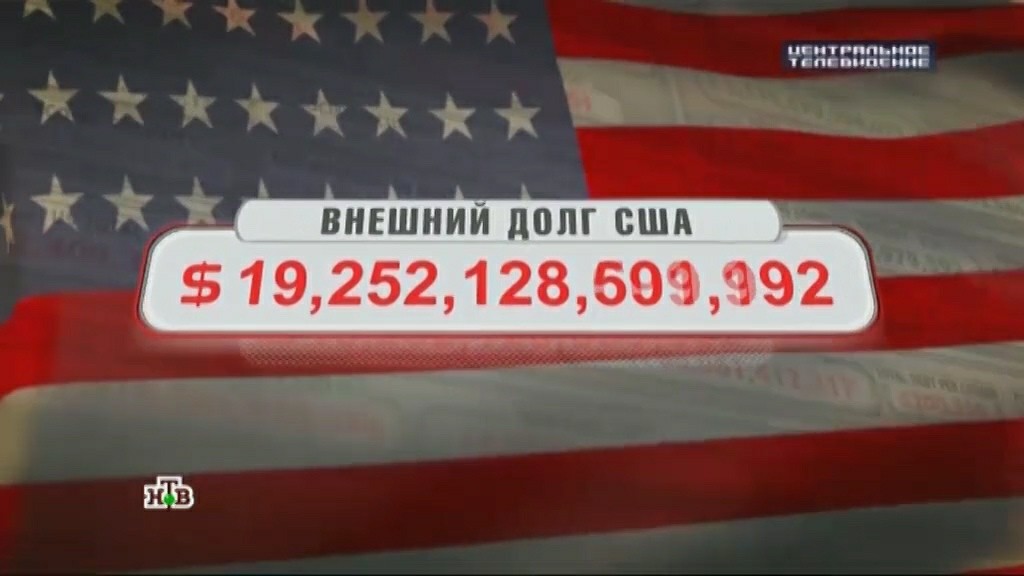
The frame shows the American flag, the headline “US External Debt,” a figure in dollars, and the NTV logo. The screen is styled as an infographic from the TV program “Central Television”: large red digits take up almost the full width, and the background leaves no doubt which country the story concerns. The number refers to the moment of filming; it is not a current estimate of the debt and should not be read as modern statistics.
In the original television presentation the sum served as the subject of a news discussion. The frame with this caption belongs to an NTV broadcast dated April 23, 2016. In the meme mock-up, the presenter and explanations are gone; only the number, the flag and the stern headline remain. It resembles a screen that must, at any moment, deliver an important message.
A political argument and a new twist
At first the image was used in conversations about foreign policy and the economy: the wording itself and the sum fit news about the US and debate about debts. Around 2018 the frame began to be combined with absurd pictures and captions. The shift did not arise from a new television story; the same screenshot became a recognizable fragment that could be inserted into a completely different scene.
The phrase “external debt” functions almost as an official label. It lends any neighboring object an excessively large scale, as if the subject were state reporting. In one usage it may be political mockery, in another simply an accidental contrast between pompous graphics and a trivial matter. Thus a new layer appeared without a new frame: the serious screen moved from political talk into jokes, where its scale becomes deliberately out of proportion to a small cause.
TV seriousness as a prop
The composition helps the joke even without a caption. The American flag sets a national scale, the number resembles data from a scoreboard, and the channel logo reminds the viewer that they are watching a TV infographic, not a random inscription. When an unrelated phrase appears next to it, it can be read as if it too were part of the official broadcast. The contrast rests on the gap between the real look of the news and a disproportionately minor object of the joke.
That is why this frame easily sheds its political meaning, yet does not become a completely neutral picture: its recognizability is built on the earlier state and financial framing. Depending on the caption, the viewer may see a parody of TV pathos, an old political polemic, or simply an absurd inflation of scale. The comic effect arises not from the number as such, but from the fact that a serious banner declares the most important something that has nothing to do with the economy.
Invented substitutions
Invented version: in place of the usual sum, the caption reads “External debt of our kitchen: one mug nobody washes.” The enormous TV format inflates a household trifle: as if a lonely dish required a state report. The joke is clear precisely because the number is replaced by a complaint familiar from a shared flat.
Another invented variant places the infographic next to a note: “External debt of the school team: three unreturned balls.” Here the scale is no longer about cleaning but about a sports team to which its own mini-budget has been assigned. Both examples keep an important part of the layout: the official tone does not match a small incident. One could also put such a screen before a story about a lost glove; the more random the object, the sharper the clash with TV seriousness.