Two in gold uniforms against a blooming arbor
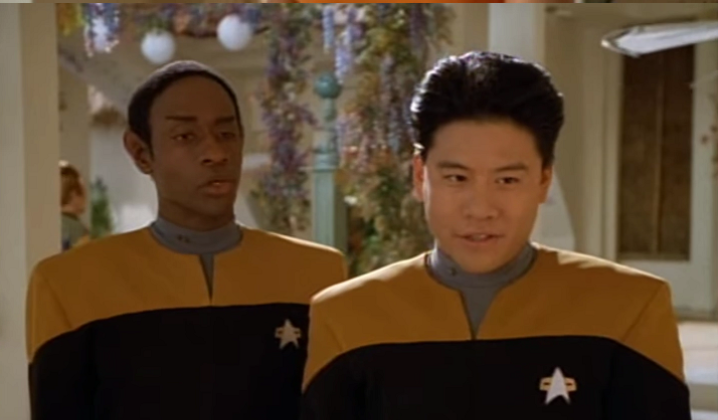
The image shows two men standing outdoors under an arbor covered with flowers. On the left, slightly behind, stands a dark-skinned man with a smooth shaved head and a serious face. On the right, in the foreground, is a young man with neatly styled dark hair and a faint smile. Both wear gold-and-black uniforms with gray turtleneck collars and a stylized star badge on the chest. It is a plain photo with no text: captions and lines are added to the meme separately.
The man on the left looks straight ahead with an impassive expression, while the one on the right seems friendly and slightly embarrassed. That difference in expression is what drives the joke: one looks reserved, the other open.
The Alter Ego episode and the question asked on the holodeck
The still comes from the third season of Star Trek: Voyager, from the episode “Alter Ego.” It aired on January 15, 1997. The script was written by Joe Menosky, and the director was Robert Picardo, who is also known as the actor who played the ship's doctor in the same series.
In the plot, trainee Harry Kim becomes infatuated with a female character from a holographic program named Marayna and asks the Vulcan Tuvok, the chief of security, for advice. It later turns out that Marayna is not just a hologram: she is a sentient being who has infiltrated the ship's computer. In the conversation, she is the one who asks the officers whether they are friends. According to episode summaries, Tuvok answers no: he regards Kim as a respected and reliable colleague, but not a friend. Kim, however, sees Tuvok differently and considers him a close person.
The exact date the template appeared is not established. It is known to have spread in 2021, when the 1997 episode again became a source of jokes.
How the joke works: two answers to one question
In the meme version, the question “Are you friends?” is asked of two characters, and their answers diverge: “No” from Tuvok and “Yes” from Harry Kim. The lines are usually placed under the frame, tied to the left and right figures: the left one answers negatively, the right one affirmatively.
The joke lies in the asymmetry. In life almost everyone has an acquaintance they consider a friend while that person sees them as merely a colleague. The meme turns that awkwardness into a short scene in which both positions are stated aloud and without hedging. Beyond relationships between people, the template is applied to pairs of things, ideas and habits that feel closely tied to one side and not at all to the other.
Caption examples
Caption “Me and my alarm clock”: “No” above the alarm clock on the left, “Yes” above the person who resets it himself every morning on the right. This works because the relationship with the alarm clock is one-sided: the person is attached to it, while it simply does its job.
Caption “My code and my comment on it”: “No” from the code, “Yes” from the comment's author, who is convinced everything is clear. The joke rests on the gap between intention and result.
Caption “Me and the fridge at two in the morning”: the person is sure of the friendship, while the fridge stays neutral. What amuses here is everyday devotion that nobody asked for.
Caption “Me and a group chat where I write only once a year”: “Yes” from the person, “No” from the chat, which no longer remembers them. The contrast of emotions makes the joke light and harmless.
How to use the template
Before writing the caption, decide which character says “No” and which says “Yes.” By habit, the left one is reserved and the right one is warm. The more specific the objects or people, the funnier it gets: general phrasing like “work and me” falls short of everyday details.
The best jokes are about relationships without hurt feelings: about gadgets, habits and places, not about real coworkers. If you caption it with the names of acquaintances, the joke quickly becomes personal. You can leave “No” without explanation and add a follow-up to “Yes,” but the short version is usually stronger.