The fine that started it all
In the autumn of 2018, in Fukui Prefecture, police stopped a monk in a long robe who was driving. According to the Japanese newspaper Yomiuri, this happened on September 16: the driver was fined 6,000 yen, about 55 dollars, with the explanation that such clothing could affect driving safety. The monk was on his way to a memorial service, and the hem of his robe reached below his knees.
The sum was small, but the story caused a stir. According to the same reports, the monk did not pay the fine and did not respond to repeated demands, so the case could have gone to court. He said that in twenty years behind the wheel, safety had been his main concern, and that if the matter went to court he was prepared to prove he drives calmly in a robe. The association he belongs to warned that too harsh an attitude toward ‘unsafe’ clothing could prevent monks from carrying out their religious duties.
The hashtag ‘I can do it in a robe’
In response, short videos appeared on Japanese Twitter under the hashtag #僧衣でできるもん, which roughly translates as ‘I can do this in monastic robes.’ The earliest dated posts are from December 30, 2018: a video with a skateboard and jump rope was posted then. Videos kept appearing in the last days of December and the first days of January. Which video was the very first is not reliably established, so the dates are best treated as a guide.
The range of scenes grew quickly: monks rode exercise bikes, boxed, danced to a popular song, played drums and xylophone, and bobbed their heads to music. The assistant to the abbot of one temple juggled clubs. Some posts also mention a monk waving a lightsaber from ‘Star Wars.’ The monks were less arguing with the police than turning the dispute into a game.
What is visible in the frame
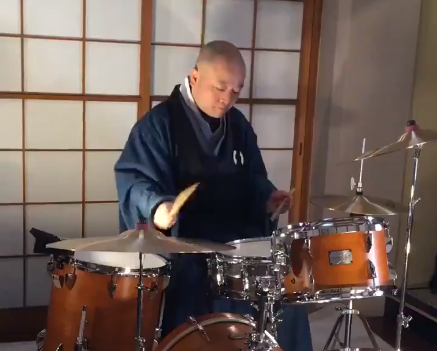
The picture shows a monk with a shaved head in a dark blue robe with a dark cloak, seated at a drum kit. His right hand with a stick is raised above the cymbal; drums and stands are visible on the left and right. Behind him are sliding partitions with translucent panels: the interior looks calm and traditional. From the frame alone one cannot tell which specific video it was taken from, so it is better not to name an author.
The joke rests on contrast. A long robe is considered a hindrance to quick movement, while in the frame the man plays confidently an instrument where speed and precision of the hands matter. The more familiar the image of a monk as unhurried and restrained, the more noticeable the gap between expectation and what he is doing.
Three captions and why they work
A few examples for this frame.
“They say you can’t drive in a robe. Fine, then drums.” The caption shifts the dispute from rules to another skill: driving is tied to responsibility, drums to rhythm, and the ban suddenly looks absurd.
“Check my safety: today it’s just sticks and a cymbal.” The word ‘safety’ is taken from the language of official protocol and becomes the source of the joke, while the action itself stays harmless.
“The hem is long, but I hold the rhythm perfectly.” The caption first admits the inconvenience, then refutes it through action: the viewer has time to believe in the obstacle and immediately sees that it isn’t there.
How to use the template
The frame suits captions about how a familiar restriction in fact doesn’t get in the way: ‘I was told I couldn’t, and I can.’ Short one-line captions work best, because the picture has no text and the meaning has to come together from a couple of words.
The target of the joke should be the absurd restriction, not the person: the monk’s appearance and private life are out of place in captions. For the format itself, the flash-mob principle works well: first name the restriction, then show an action that contradicts it.