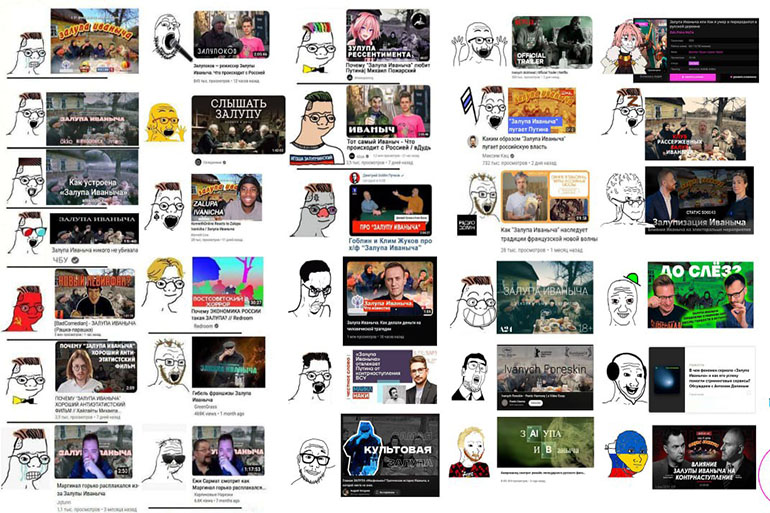
A film that does not exist
At the core of the meme is not a real film, but a collective invention. Users design a frame or poster as if it were a picture with a famous director, actors, a festival history and dozens of reviews. The title sounds deliberately crude and provocative; next to it may stand a serious synopsis, a pseudo-archival poster or a confident review. The mismatch between form and subject is the main comic effect.
The template has no single mandatory set of characters or final plot. In one version the film turns out to be an arthouse drama, in another a lost classic or a box-office flop. Each new post can add to the shared legend, contradict a previous detail, or parody a different type of film content. Therefore the picture works better as an invitation to a collective game than as a retelling of a single canon.
How the pseudo-history forms
The series began to spread on Russian-language social networks in 2023. Participants used the visual culture of reviews and posters: a large headline, a frame with an expressive face, a short quote supposedly from a critic, a mention of an award or release year. These elements are usually recognizable on their own, and together they look convincing enough for a reader to doubt for a moment whether the film exists.
Later, alternative posters, “retrospectives,” reviews by various bloggers and new versions of the picture’s origin began to appear. These are not traces of a genuine advertising campaign, but parts of a hoax. It is important to check a specific publication before sharing it as a cinematic fact: the meme deliberately imitates confident documentation and can mislead outside the community’s usual context.
Why the invented film is easy to believe
Viewers are used to encountering fragmentary information about old or low-budget films: someone posts a frame, another adds a retelling, a third finds a supposedly forgotten interview. The meme borrows this structure and fills the gaps with invented facts. The serious tone becomes part of the joke: the calmer the absurdity is presented, the more noticeable the contrast with the title.
The series also parodies the culture of expert opinions. The poster seems to promise a deep analysis, but the whole “history” rests on piling up invention. When the audience already knows the rules of the game, each new review reads as improvisation. For a newcomer, however, the reference may be unclear — so it is useful to add a short marker that the film is fictional if the post goes beyond the meme community.
Examples of continuing the joke
One can make a “rerun poster” where the venues are not cinemas but friends’ kitchens, and the screening starts after someone finds an old projector. This version keeps the style of an official announcement and transfers it to a domestic situation. All invented dates and venues should be perceived as part of the humor.
Another option is to write a review of the film without describing a single scene: “By the third act the viewer already understood that this was the very film that never existed.” Here the pseudo-critical language turns back on the legend itself and emphasizes its conventionality.
One can stage a dispute between two invented reviewers: one writes “this is the most underrated film of the decade,” the other replies “the best scene of the picture accidentally ended up in the final credits and never resurfaced.” The more serious the format and the clearer the absurd contradiction, the stronger the parody.
The crude title and the limits of humor
The title contains obscene language and may be inappropriate in a work, study or children’s environment. The meme itself mocks invented cultural importance, but the crude word can distract the audience from this mechanism. If you need wider reach, it is enough to describe it as a joke franchise and not to repeat the expression in every subpoint.
Do not attribute a real director or actors to the invented film without clear parody labeling. This easily turns the game into a false message about a person. Distinguish a real photograph used as a visual basis from a fictional role attributed to it. The meme keeps its expressiveness without substituting real biographical facts.