What the picture shows
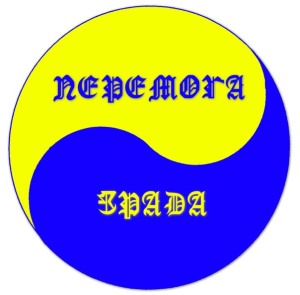
The image shows a circle divided into two halves resembling a yin-yang symbol: the upper part is yellow, the lower part is blue. These colors match the colors of the Ukrainian flag, which immediately sets up the national symbolism. The words are written in a large font with decorative serifs, styled to look like old-fashioned typography.
On the yellow half, the word "PEREMOGA" is written in blue letters, and on the blue half, "ZRADA" is written in yellow letters. Placing the words in different halves of the circle emphasizes their opposition, while at the same time each word seems to spill into the other part of the image, so the two sides turn out to be inseparable from each other.
Meaning and origin
The word "zrada" in Ukrainian means betrayal, treachery, or deception, while "peremoga" means victory. Together they form a pair describing the swings between disappointment and success, and it is precisely this duality that made the expression popular.
The expression spread during the Euromaidan protests in Kyiv in the winter of 2013-2014. Protest participants and commentators used it to assess political decisions and events: "zrada" denoted betrayal by leaders, while "peremoga" denoted even minor achievements. The authorship of the phrase has not been established in open sources; it took shape as a settled colloquial turn of phrase.
Over time the words moved online, primarily into Facebook, where they became captions for news items and comments. Publications devoted to the vocabulary of the Maidan record them as characteristic examples of the revolution's colloquial speech.
How it's used
In its ironic sense, "zrada" is used to denote disappointment, an unexpected letdown, or an injustice, while "peremoga" is used to assess dubious successes. The pair of words is often placed side by side in a single phrase to emphasize that the outcome turned out to be ambiguous.
The yin-yang image serves as a visual form of the expression: it is posted in discussions of politics, sports, and everyday events. Sometimes the caption includes a clarification of exactly what counts as the betrayal or the victory, and this kind of play with meaning makes the meme flexible.
Its use extends beyond the Ukrainian language: in Russian-language comments the words are used without translation, relying on their recognizability. Sometimes they are also applied in a joking tone, for instance when some trivial everyday matter suddenly becomes a "victory" or a "betrayal."
Why the expression works
The meme's main strength lies in its concise antithesis. Two short words with opposite meanings are easy to remember and allow a complicated emotion to be expressed in a single phrase, without a lengthy explanation.
Sound and visual symmetry reinforce the effect: the words are similar in length and rhythm, and the circle split into two halves suggests the idea of an endless cycle of events. This turns the expression into a universal code for assessing any ambiguous outcome.
Finally, the meme retains its political origin, but online it is often used outside of any political context. This shift in register makes the expression understandable to a broad audience, although its original meaning remains important for understanding Ukrainian public discourse of the 2010s.