First there was Gru's voice
Gru appeared in the Illumination film Despicable Me in 2010. He makes grandiose villainous plans and gradually becomes the father of three girls, so addressing girls fits naturally into his speech. In the English version the character is voiced by Steve Carell. His exaggerated accent turns the familiar “girl” into a sound that users conveyed by writing “gorl.”
The internet joke grew out of a single, easily recognized pronunciation. The letter o serves as a pointer to the voice: the reader does not just notice an error in the word, but mentally assigns the line to Gru. This substitution does not require copying an entire film scene. A face with a long nose and a word that can be read in his manner is enough.
From a typo to musical photomontages
A notable early tweet by @OffTopicMica about the spelling “gorls” appeared in mid-April 2018. At the end of the same month @RobertLaing_ posted a version with Gru’s face on Katy Perry, connected to “California Gurls.” The technique that caught on let people swap recognizable musical and screen images in which words about a girl or girls are central.
By early May there were numerous variants. A modern collection dated May 1 already included the Beyonce Gru montage and a tweet by @masefaceeee from April 30. This marks the trace of the early spread of one specific variety, not an established authorship of all later copies. The popularity of the word and the popularity of the photomontage are close in time here, but the emergence of the cartoon voice is separated from them by eight years.
Beyoncé, the cap, and the wrong face
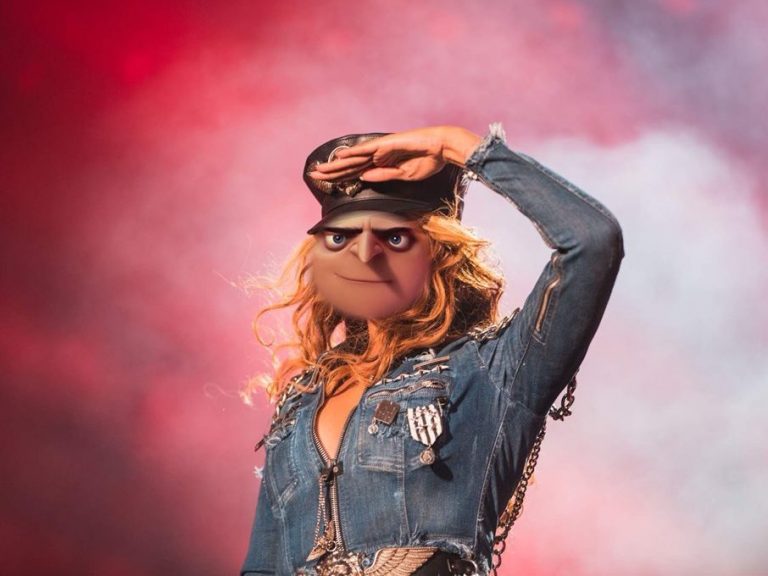
The figure has long light hair, a black peaked cap, and a denim jacket with patches, badges, and chains. One hand is raised to the brim, with pink smoke behind. All of this preserves Beyoncé’s stage image. Instead of the singer’s face, a serious Gru looks out: his large nose, eyebrows, and cartoon proportions immediately reveal the manipulation.
The picture itself has no song line and not even the word “gorl.” So it works as a silent reference for someone familiar with the format. The stage gesture promises a dramatic entrance by the singer, while the face in advance suggests a different voice. The author of the original concert photo, the shooting date, and the creator of this specific file are not established; the image does not indicate which performance the source is from.
What one vowel changes
A usual face swap with a celebrity creates a visual collision of two people. Gorl has an additional sound-based reason: the new face seems to take the line for itself. Looking at the musical image, the reader recalls the performance, then attaches Gru’s pronunciation to it. The result is a small imaginary voice-over without an audio track.
Carell’s recognizable acting manner ties together disparate pictures: the costumes change, while the imagined performer stays one and the same. The easier it is to recall the expected voice or the title of a work, the more noticeable the intrusion of another’s character. That is why popular covers and stage costumes become convenient backdrops for this single phonetic substitution.
Three imagined meetings with gorls
In an invented sketch, a company hosts a home karaoke evening and prints an invitation that says Girls’ Night. One participant changes a vowel, adds Gru’s face over a group photo, and gets Gorls’ Night. Now an ordinary friendly invitation promises a chorus in which everyone somehow speaks in one cartoon voice.
Another variant is the cover of an imaginary detective story, Gorl Detective. Gru gets a magnifying glass, a school bag, and the outfit of a heroine who solves the mysteries of a dormitory. The replacement turns the familiar role of a girl detective into the performance of an imperturbable villain who has appropriated someone else’s profession.
In a third example, an English-language enthusiast writes a list of characters for their own computer game and by mistake types “gorls.” A friend replies with a portrait of Gru in every in-game costume. A typo from a spreadsheet becomes a visual explanation: now all the heroines seem to have been handed to one unexpected voice actor.