Examples of captions: thoughtfulness without words
The gesture itself is familiar to everyone: a hand at the face, a glance to the side, a pause before a decision. It can be placed under almost any caption, and the viewer will guess that doubt stands behind it.
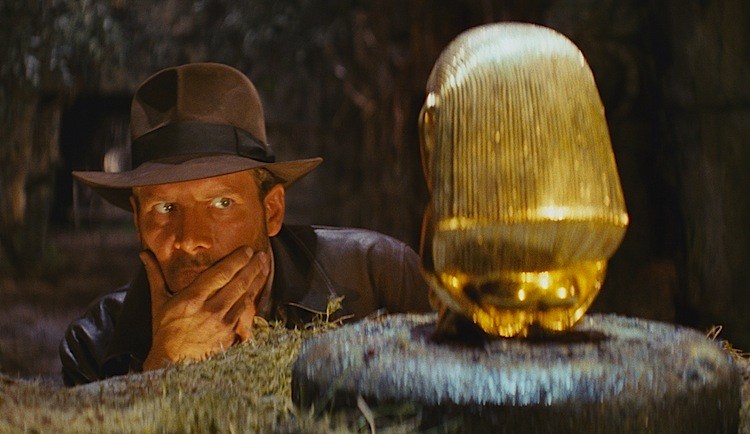
“I'll double-check that we're not touching the statue.” The caption turns an adventure scene into everyday caution. It is funny because in the film the idol is both a treasure and a danger, while here the matter is trivial.
“I'll update the spreadsheet, but only after lunch.” This example moves the gesture into an office. The gap between the serious pose and the dull task creates the comic effect, because the viewer expects a great decision and gets an ordinary plan.
“I think this is either a bug in the code or a sign from above.” The line offers two options that are equally alarming. The joke rests on hesitation: the pose suggests deep thought, while the text suggests that the choice changes almost nothing.
The scene from the film
The shot is taken from the film “Raiders of the Lost Ark” (in Russian distribution the film was also released under another title, “Indiana Jones and the Thieves of the Lost Ark”), directed by Steven Spielberg, 1981. The frame shows Harrison Ford in a hat and a dark leather jacket, with a golden idol standing on a stone pedestal in front of him. The hero peers out from behind a grassy edge and presses his palm to his chin. Light falls on the idol from the side, while the rest of the scene is lost in shadow.
The golden idol is the key object of the film's opening sequence: the hero reaches it in a temple full of traps. For the meme, only the pose matters: a man considering what to do next and not rushing. This pause became the most recognizable moment of the frame.
What the pose says
A palm at the chin is a classic sign of contemplation. The viewer sees both the intense gaze and the slightly narrowed eyes, and this creates the image of a man who sees the problem before anyone else does.
That is why the frame is convenient to use as “I'm weighing this up,” when a decision is clearly dubious or when the caption's author is hesitating too. The laugh comes from the gap: a serious face and a trivial or absurd task.
The viewer does not need to be convinced of the hero's shrewdness: the pose alone signals that the pause will be followed by a choice. That is why the caption can be kept short, without explanation.
What is known about the origin of the template
When this pose was first captioned as a meme is not known: there are reviews of the film and the actor, but the first publication of the captioned frame is not. So the first meme post can only be described as unknown.
The image of Indiana Jones has become a cultural reference point in general, and online it is often used to mock heroes who are too sure of themselves. Knowing the film is not necessary for the caption: the viewer sees the thoughtfulness and understands it without context, which is why the template transfers easily to any topic.
It is also worth remembering that the film's scene does not end with contemplation: right after this pause the hero decides to swap the idol for a bag of sand, and the trap goes off anyway. This detail makes any caption about a “well-thought-out plan” slightly more ironic, because the viewer knows how it ends.