What this meme is
#PutinKrut is a hashtag under which posts praising Vladimir Putin began to appear on the social network VKontakte in December 2017. The name is made up of two words, "Putin" and "krut" ("cool"), and from the very start the hashtag was used as an ironic formula. The catalog's description characterizes it as a meme that mocks the president and is used as a synonym for death or murder. In the article, this characterization is presented as the catalog's assessment, not as an established fact about the intentions of the posts' authors.
It is important to separate two parts of the phenomenon: the hashtag itself, which was used en masse, and the interpretation that became attached to it within the user community. The first part is described in media coverage. The second rests on the reaction of communities and comments, and its boundaries are described incompletely in the sources.
Origin
The author of the hashtag and the original idea have not been established. It is known that posts with this hashtag became noticeable to VKontakte users on December 17, 2017, roughly three days after the president's press conference, held on December 14. According to media reports, such posts were offered to the administrators of several communities. Some of them contained the logo of the Young Guard of United Russia. At the time of the first publications there was no official response from the youth movement.
The timeline is described from several sources, but no direct link between the hashtag and a specific campaign has been established in them. The coincidence in timing with the press conference became one reason for discussion, but not proof of deliberate coordination.
Posts from the accounts of deceased people
The most notable feature of the episode is that some of the posts were published in the names of people who had died by that point, or from inactive pages. In one of the described cases, a post appeared in a city community on December 15, even though its author's page had a post reporting their death in 2013. In another case, the account was blocked, and according to screenshots it had not been active since 2013.
The social network's press service said in an update that the accounts of deceased people had been hacked. The administrators of one community suggested a version in which the posts had been prepared in advance, before the owners' deaths, and were edited only after the press conference. The authors of this version rejected it, pointing out that the first post in their community appeared roughly six months after its author had stopped being active on the network. There is no final conclusion in open sources.
The image in the catalog
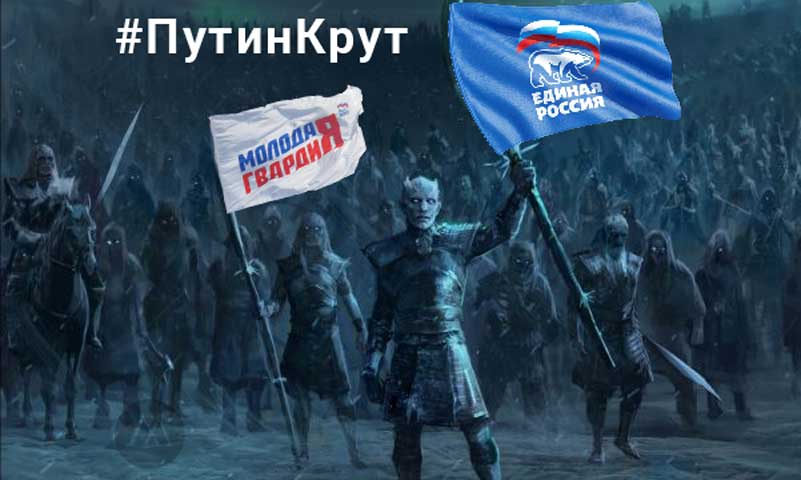
The illustration attached to the catalog entry does not fully match the description. It does not show a portrait of Vladimir Putin. It shows a scene in the style of a fantasy series: a column of warriors in dark cloaks and armor on snow-covered terrain, with a figure holding a raised banner in the center. The hashtag is written above the scene, and two flags bear the symbols of Molodaya Gvardiya and United Russia.
The frame itself does not establish any connection between the image and the president. Readers should bear in mind that the illustration reflects party and youth-movement symbolism rather than a photograph of the head of state.
How the hashtag was used
Within the user community, the hashtag quickly acquired a second layer of meaning. Because the posts appeared in the names of deceased people, the formula "krut" itself began to be perceived as an ironic reference to death, and the hashtag became associated with dead accounts. This, according to the catalog's description, is what made it a kind of conditional synonym for death or murder.
Users applied the hashtag in comments and in parody captions, where the literal sense of praise contradicted its source. The device relies on a mismatch between the formula and the context: an approving phrase turns out to be a grim joke. No lasting spread beyond VKontakte has been recorded in open sources.
Context
The meme belongs to the politically charged statements of the 2017 internet and is tied to a specific episode. Its description in the article contains no assessment of the political figure: the facts about the hashtag, the accounts, and the platform's response are presented as they were recorded in the coverage.
Readers interested in the topic would do well to check the details against primary sources, since part of the information in the sources is relayed from reports without independent verification.