What's drawn
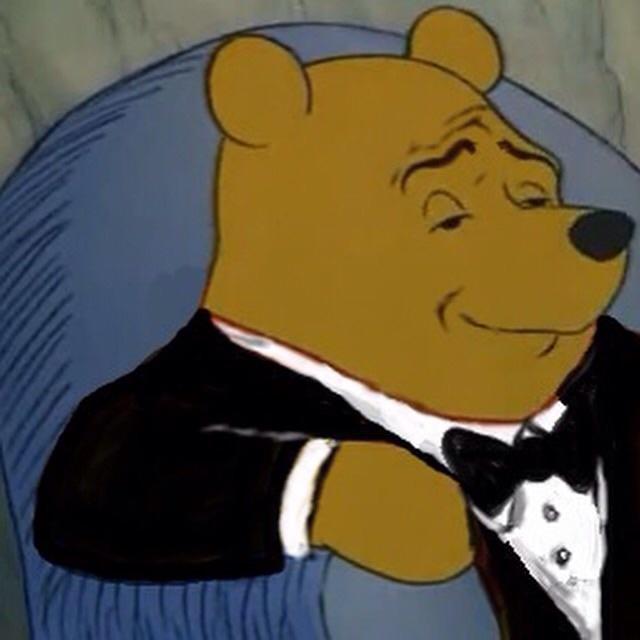
The character is recognizable by the yellow face, round ears and black nose familiar from cartoons about the bear. He wears a black tuxedo with a white cuff, a white shirt with shiny cufflink-style buttons and a black bow tie. The bear sits in a blue armchair with hatched upholstery; behind him is a gray marble background.
The face conveys the main thing: eyelids half-lowered, left eyebrow arched, corners of the mouth lifted. This is how a person looks when they're pleased with themselves and believe they understood everything before anyone else. The outlines are uneven in places, and the tuxedo looks painted over the original frame, meaning we're looking at an amateur digital edit rather than a frame from a cartoon.
What is known about its origin
Winnie the Pooh himself was created by writer A. A. Milne and later became a hero of Disney cartoons. The tuxedo, however, came from an online edit: who exactly drew or edited this version and when it first appeared online could not be reliably established, so neither an author nor a date can be given.
It's only known that the picture became a universal template for ironic presentation: it's placed next to a regular Winnie the Pooh to show the 'ordinary' and 'refined' versions of the same thought.
Why the image works
The meaning rests on the contrast between a children's character and an adult dress code. The guileless bear looks as if he has come to a society reception, and that makes his self-satisfaction funny.
The expression matters more than the clothes. The half-smile and raised eyebrow make the frame a reaction to a small victory, refined taste or someone else's naivety, rather than a major event. The smaller the occasion, the funnier the solemn pose.
Three captions and how they work
Three made-up variants below: the expression is the same, only the occasion changes.
'The office coffee is instant again, but I drink it with the air of a sommelier.' A mundane occasion and a solemn delivery create an unexpected gap.
'My contribution to the discussion: I approve without comment.' The short phrase sounds like a verdict, and the picture confirms the speaker's confidence.
'I ordered pizza with pineapple and now I consider it gastronomic daring.' The sarcasm rests on self-irony: the tuxedo emphasizes a decision the speaker made themselves and then mocks.
In all three cases the caption sets the scale, and the picture adds the gravity.
Where it fits
The frame suits reactions to lucky little things, ironic approval and self-irony. It works poorly if a real conflict between people stands behind it: then the irony turns into a hurtful jab.
A good sign that the picture fits: the caption can be read aloud with a straight face and still make you laugh. If the caption needs explaining or relies on someone else's slip-up, it's better to change both the image and the wording, because here the tuxedo works as a joke about the speaker themselves.
Another technique: place two frames side by side, a regular Winnie the Pooh and this one, and give them two versions of one phrase, a plain one and a fancy one. The difference in delivery is the joke, and the tuxedo just underlines it. This format helps show how the same action looks in the eyes of a self-assured person.