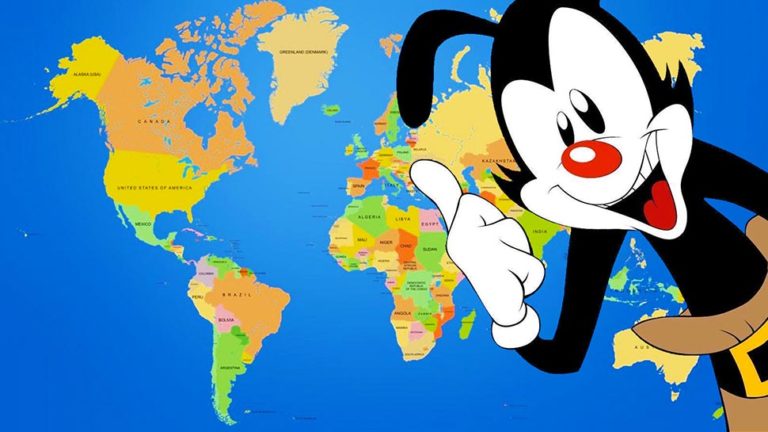
What the picture depicts
The frame has two parts: on the right is a large close-up of Yakko with a red nose and a wide grin, pointing with a white gloved finger, and on the left and in the center is a blue background with a political world map. On the map one can read the labels Canada, United States of America, Mexico, Brazil, Peru, Bolivia, Algeria, Libya, Egypt, Kazakhstan, and to the north Greenland (Denmark); many of the names are small.
The picture works as a title card: the character and the map together immediately recall the song, even without sound. The bright colors of the map and the confident gesture of the hero convey the same feeling as a musical number: fast, loud and with a smile.
Where the song came from
The series “Animaniacs” began airing in September 1993. According to meme catalogues, the country song was already heard in the second episode. The lyrics were written by the screenwriter and songwriter Randy Rogel, and the song is performed by Yakko, voiced by Rob Paulsen.
In interviews Rogel said he did not intend to create a geography lesson, but the number turned out well, and the producers soon began asking for more educational songs. The melody was taken from “Jarabe Tapatío”, known as the “Mexican hat dance”: it is familiar to almost everyone and suits fast patter.
How the list of countries is built
The number is structured like a tongue twister: the countries come one after another, rhymes are used within the lines, and the tempo keeps rising. This device helps people remember the names even if they don’t know where they are on the map. The list is presented not as a reference but as a speed contest between the singer and the listener.
The song names nearly all the states that existed in 1993. For that reason its list is long outdated: many countries appeared or changed their names after the series aired. This has become one of the main reasons for remakes.
Remixes and outdated geography
Online, the song has been reworked many times: parodies, remixes and meme versions have appeared. Some authors edited film clips to the melody, others laid unrelated scenes over the track, and there were also videos listing the original’s inaccuracies.
In 2017 Rob Paulsen performed the song on camera and added a verse about countries that had appeared or changed since 1993. This shows that the joke can be updated: it is enough to add the missing part of the list, and the number sounds current again.
Caption examples and how they work
“Asked where the file is, and got an answer covering every folder on the drive.” The rhythm of the enumeration is familiar from the song: it seems the list will never end, and the question drowns in details.
“Ordered a coffee, and the barista started listing all the varieties.” Here the shift from a simple request to an endless catalogue works on contrast: a short line turns into a long number.
“Looking for the report: first in email, then in the cloud, then in chat, then in the fifth folder.” The list grows with each item, and the final punch lands on a point where nobody expects it.
All three captions use the song’s structure: enumeration, acceleration and an unexpected stop at the end. What is funny is not the number of items but how the tempo grows, so captions are better kept short.
How to use this template
The template fits captions about long enumerations, step-by-step explanations and endless clarifications. The smoother the rhythm of the text, the stronger the parallel with the song. The map in the background helps if the joke is about travel, routes or listing places.
If a caption touches on geography, it is better to check the facts against current data: the song reflects the world of 1993, and its list no longer matches today’s.