What the photo shows
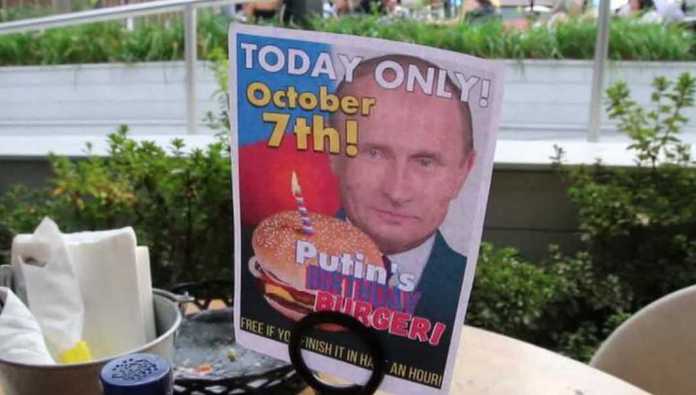
The picture shows a flyer set on a table outdoors. A large line at the top reads “Today only October 7th”; next to it is a portrait of Vladimir Putin and a burger with a candle. The caption “Putin's Birthday Burger” names the advertised item, and the small text at the bottom, partly hidden by objects on the table, promises a free burger on condition that it is eaten within the allotted time.
It is not known who made the flyer or when the photograph was taken. The flyer itself became widely known as the illustration for a story that was later debunked.
The 2017 story
In early October 2017, the news agency Ruptly, owned by the television channel Russia Today (RT), spread a segment about the New York restaurant Lucy's Cantina Royale. In the video, an employee of the establishment, Tamara Ilizarova, said that for Vladimir Putin's 65th birthday guests were served a burger weighing 1,952 grams, matching the year of the president's birth. The segment was shown on Russian federal channels.
The segment quickly became a subject of discussion. The restaurant responded that it had never celebrated Putin's birthday and had never served such a burger, and that the employee, according to a representative of the establishment, had lied about making a training project. The news agency TASS cited a manager named Ted Brian, but according to the restaurant, no such employee had ever worked there.
The staff were suspended from work pending an investigation. Later, one of the employees was fired, as Russian outlets reported in October 2017. The restaurant turned the matter over to its lawyers.
The channel's reaction
RT representative Anna Belkina stated that the channel had no reason to doubt the segment, since the manager had confirmed the information from the TASS agency. However, on October 9, 2017, the video was removed from the channel's resources, and the story became known as an example of a fabricated segment.
Why the name became a meme
The name “Putinburger” stuck to a story that was spread as real but turned out to be made up. Online, the word became a label for a fake and is used ironically to describe a story that looks too convenient or absurd to be checked.
The picture of the flyer made it easier to spread: a bright portrait, a clear caption, and an image of food made it recognizable. Publications of the time called the story a myth and a fake, and this cemented its status as an example of false news.
Usage
Today the expression is used in discussions of media and fact-checking. It is often cited as an example of how a story can go on air without sufficient verification, and how responsibility for spreading it is shared among agencies, channels, and publications.
The meme remains neutral in character: it contains no judgment of political views and concerns a specific story and its debunking. That is why it remains a clear reference for those interested in how false stories spread.